2 fully funded PhD positions (commencing 2027)

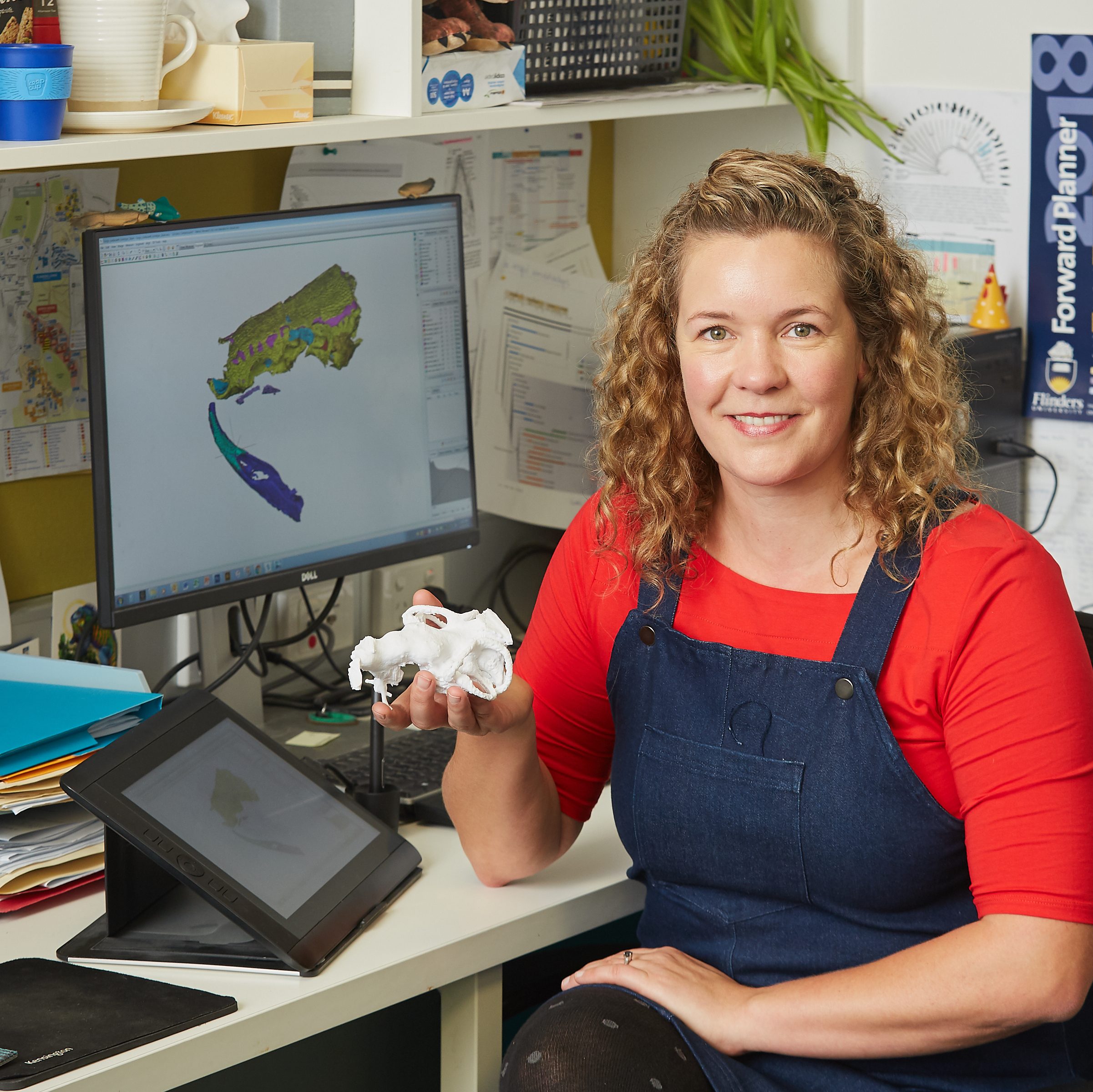
I am very pleased to announce that I have two fully funded PhD positions available to work in my lab commencing 2027. These positions are funded as part of an exciting Australian Research Council-funded project led by Dr Alice Clement (https://www.flinders.edu.au/people/alice.clement) and based at Flinders University, Adelaide, Australia, with links to several other national and international research institutions and collaborators.

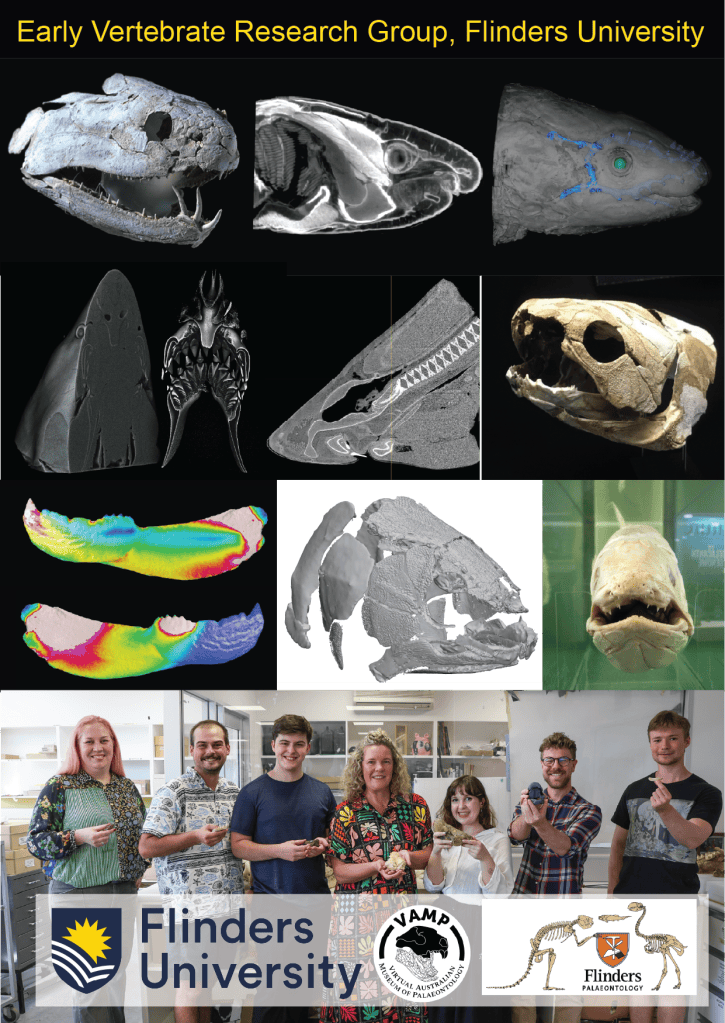
Both of these evolutionary biology-based projects will unite ‘digital’ morphology with cranial evolution of fishes (either chondrichthyans or osteichthyans), relying heavily on synchrotron imaging of exceptional and rare specimens. Join our vibrant Early Vertebrate Evolution research group within the wider Palaeontological Lab at Flinders University. Currently we have five PhD students, and two Honours students, studying taxa as diverse as placoderms, early tetrapods and lungfish. Beyond the “fishy” group, others at Flinders University work on mammals, birds, reptiles, and invertebrates spanning the Palaeozoic to the Cenozoic.

1, evolution and palaeobiology of coelacanth fishes; Project 1 will examine coelacanth evolution using fossils from the Palaeozoic (Australia and Canada) and Mesozoic (Greenland), and scans of the living Indonesian coelacanth (Latimeria menadoensis), and with potential for travel to Indonesia.

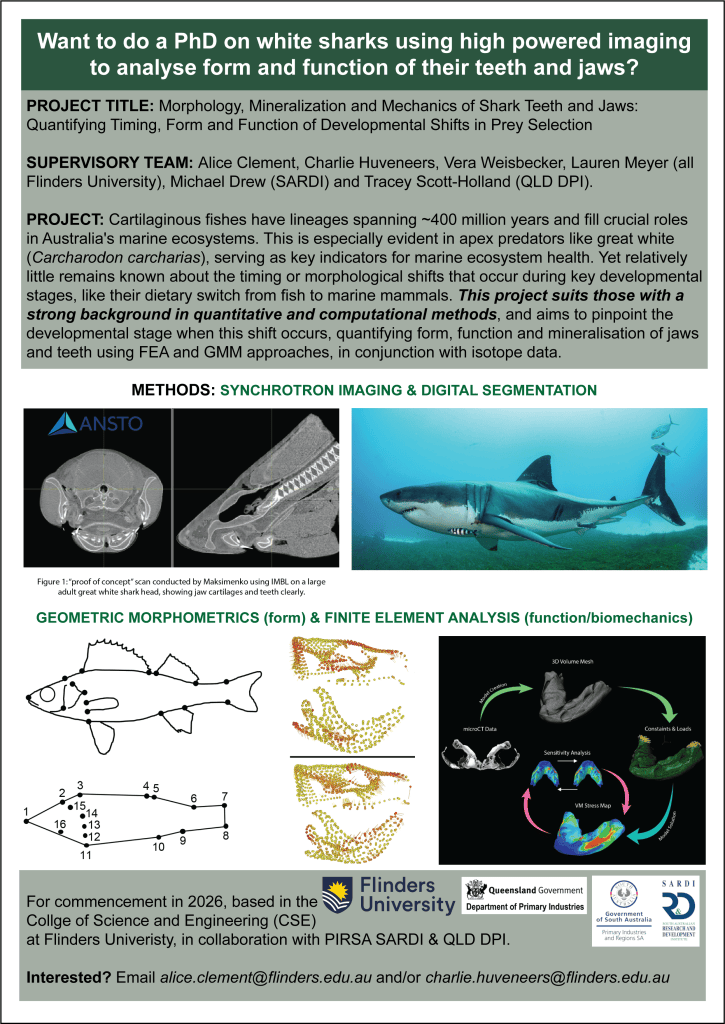
2, the cranial anatomy, morphology and biomechanics of living sharks; Project 2 uses a synchrotron-imaged ontogenetic sequence of white shark (Carcharodon) specimens, as well as a range of other living sharks from Australia, and will use geometric morphometrics (GMM) and Finite Element Analysis (FEA) on digital data. This project will be co-supervised by those in the Southern Shark Ecology Group (SSEG).

  • The PhD stipend is $37,143 AUD per year, for a duration of 3.5 years
  • Positions are open to local and international applicants
  • Closing date for applications is January 15th 2027, for commencement at any point in 2027

To learn more, and apply please follow this link: https://www.flinders.edu.au/scholarships/cranial_evolution_digital_morphology_and_palaeobiology_of_fishes_early_vertebrates

To learn more about the Clement Early Vertebrate Evolution Lab, follow Alice on BlueSky @DrAliceClement
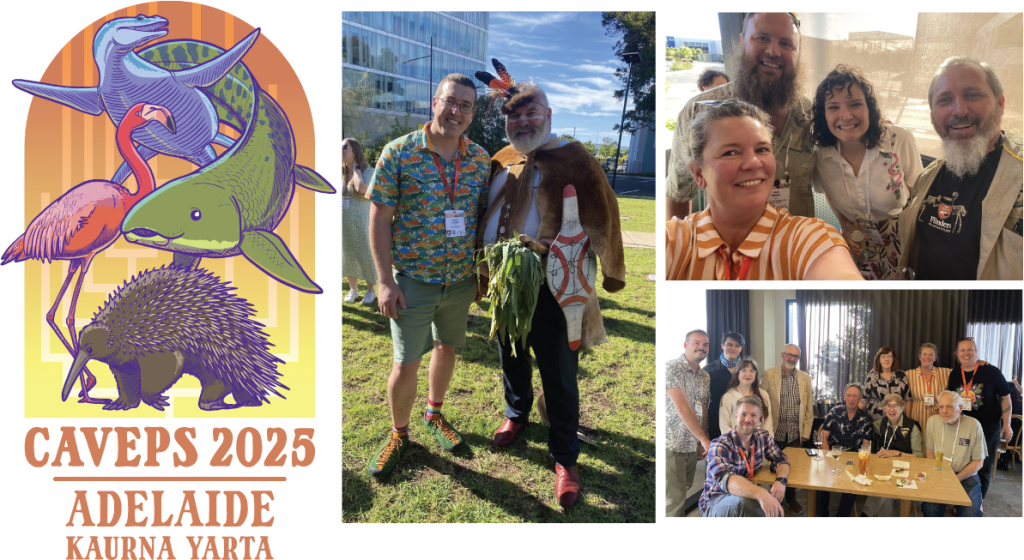
CAVEPS 2025

Well, what a week it was! During the last week of November (yes, sorry this post is so late!), we hosted some 200 palaeontologists on Kaurna Yarta / Adelaide for the 19th Conference of Australasian Vertebrate Evolution, Palaeontology and Systematics (CAVEPS) 2025.

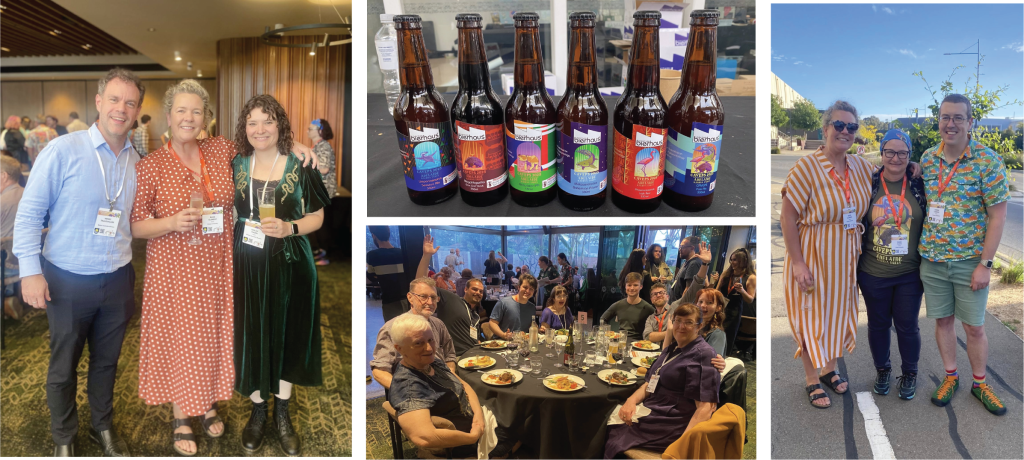
Aaron Camens and Uncle Micky at the welcome to country ceremony (centre), enjoying the welcome function at the Mantra with friends and colleagues (right).

CAVEPS is a multidisciplinary forum for vertebrate palaeontologists, earth scientists, evolutionary biologists, and fossil enthusiasts from Australasia and beyond. The conference features the latest research in vertebrate palaeontology, including morphology, phylogeny, systematics, evolution, taphonomy, development, zooarchaeology and palaeoecology. The event is generally held every two years or so, and hosted by different institutions around Australia and New Zealand.

We provided pre- and post- conference field trips, where participants unearthed some important fossil finds ! By holding this conference here in South Australia, and holding field trips at the Naracoorte Caves and Ikara‑Flinders Ranges, we hoped to highlight the unique geological and fossil-heritage of this particular and spectacular part of Australia.

Before the main conference program, we had “Workshop Monday”, where attendees could participate in a range of workshops covering everything from submitting to high profile journals, bench-marking and bibliometrics, media training, musculoskeletal modelling, 3D digital reconstruction and animation, moulding and casting, and aworkshop covering best practises for collaborating with indigenous peoples.  

Enjoying ourselves at the conference dinner, at Marion Hotel (left and middle); Alice with conference co-organisers Diana Fusco and Aaron Camens (right).

Over the subsequent 4 days, the CAVEPS scientific program featured 78 scientific presentations and 35 posters covering all the facets of vertebrate palaeontology and evolution. We were also very privileged to have four fantastic invited plenary speakers:
o Prof. Robin Beck (University of Salford) on metatherian systematics;
o Dr. Jacqueline Nguyen (Australian Museum / Flinders University) on songbird evolution;
o Dr. Peter Bishop (Harvard University) on synapsid locomotor evolution;
o Mr. David Elliot OAM (Australian Age of Dinosaurs) telling us all about AUSTRALIA’S GREATEST UNTOLD STORY.

I’m extremely proud to have been a part of THE BIGGEST CAVEPS ever, and it is great to see so many students, making up >55% of all attendees. The future seems to be in good hands. It was a mammoth (Diprotodontian?) effort to bring this event together, and I certainly couldn’t have done it without the support and enthusiasm of my co-organisers, Dr Diana Fusco and Dr Aaron Camens, the generous support from our sponsors and Flinders University, along with a veritable assemblage of amazing volunteers! I am very much looking forward to attending (and not organising) the next one over in Otago, New Zealand in 2027!