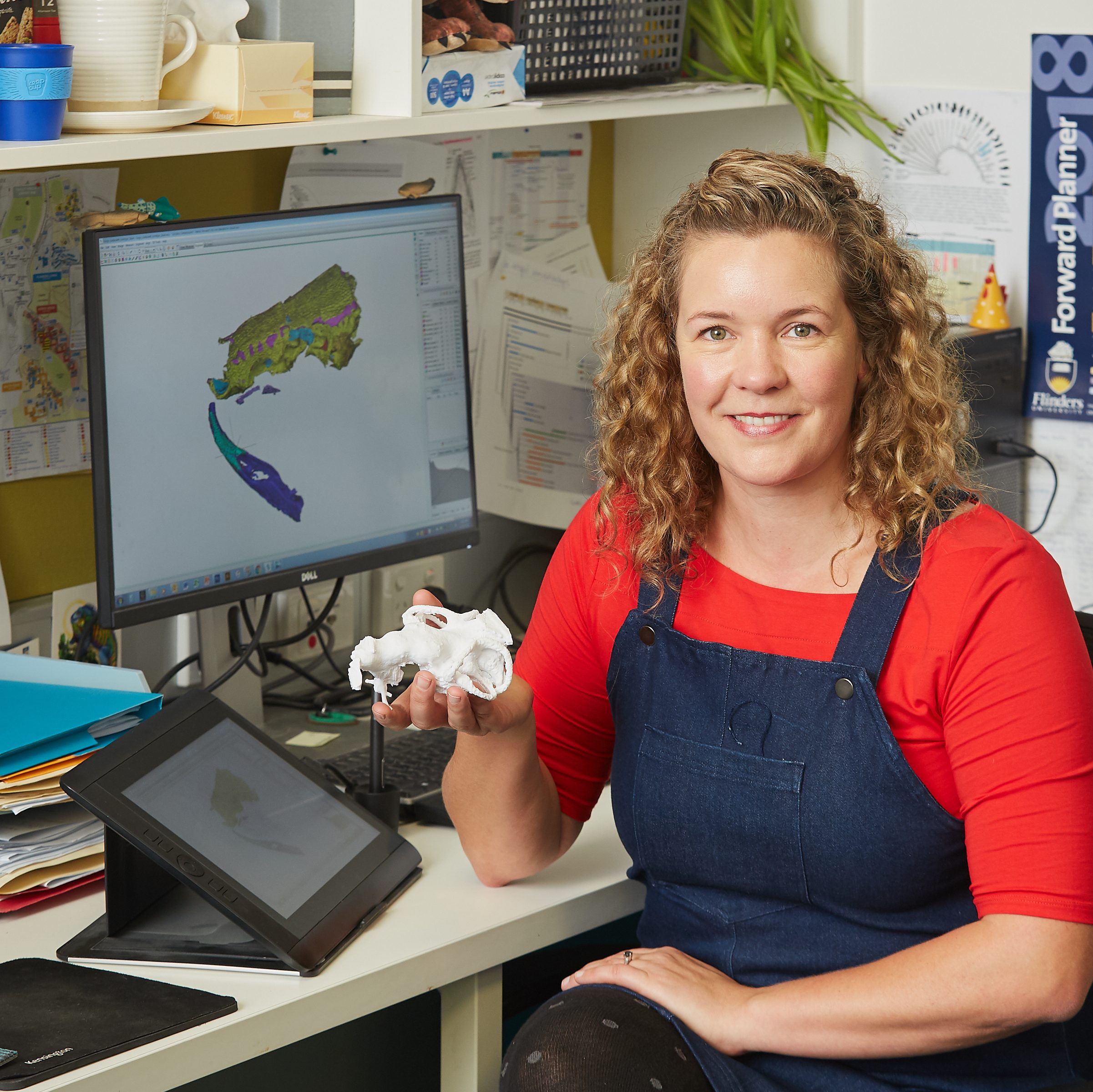
The enigma from Gogo

ENIGMA /ɪˈnɪɡmə,ɛˈnɪɡmə/

noun, a person or thing that is mysterious or difficult to understand.

Since 2011, there has persisted a mysterious specimen known from the Late Devonian Gogo Formation in Australia. Dubbed Cainocara enigma by authors Ken Campbell and Dick Barwick, who first studied it, they published a work entitled “A new unusual Osteichthyan fish from the Gogo Formation, Western Australia“, but considered this single specimen so strange that they could not identify it any further than some kind of bony fish…

Fast forward to 2024, and enter my dedicated and hard-working 3rd year research student, Hannah Thiele, who used CT scans of this, well, BLOB of a fossil (there really is no other way to describe it!) and specialised 3D segmenting software to solve the mystery of just what the enigma really was!
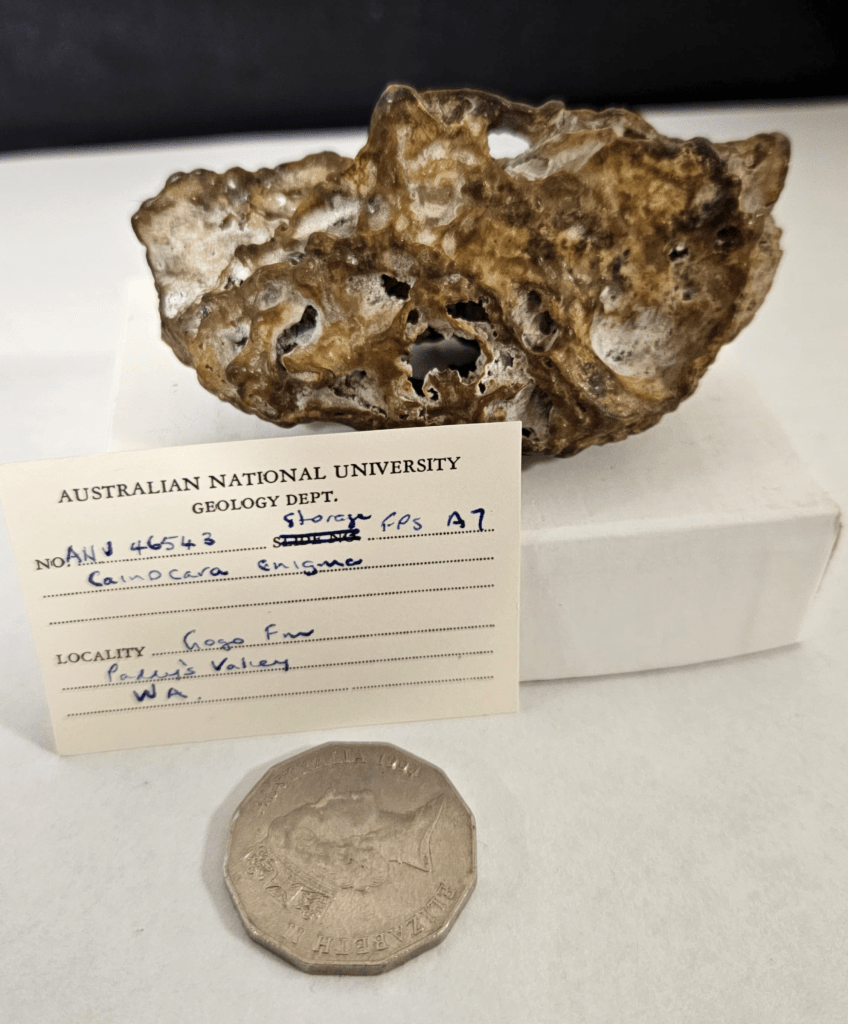
By reconstructing the internal space of this mysterious fossil, Hannah was able to identify a cranial endocast, the space inside the skull that usually houses the brain. In doing so, we could identify features that helped us to orient the specimen correctly and interpret it accurately. This meant we could solve the mystery once and for all!

We deduced that the enigma from Gogo was most likely the poorly-preserved, and heavily-weathered braincase of a lungfish. Exactly which one we don’t know, but something similar to the short snouted forms such as Chirodipterus or Holodipterus.

Hannah, together with myself and colleagues John Long (Flinders) and Joseph Bevitt (ANSTO), published a paper detailing the results earlier this year in the Canadian Journal of Zoology, with “Deciphering Cainocara enigma from the Late Devonian Gogo Formation, Australia“.
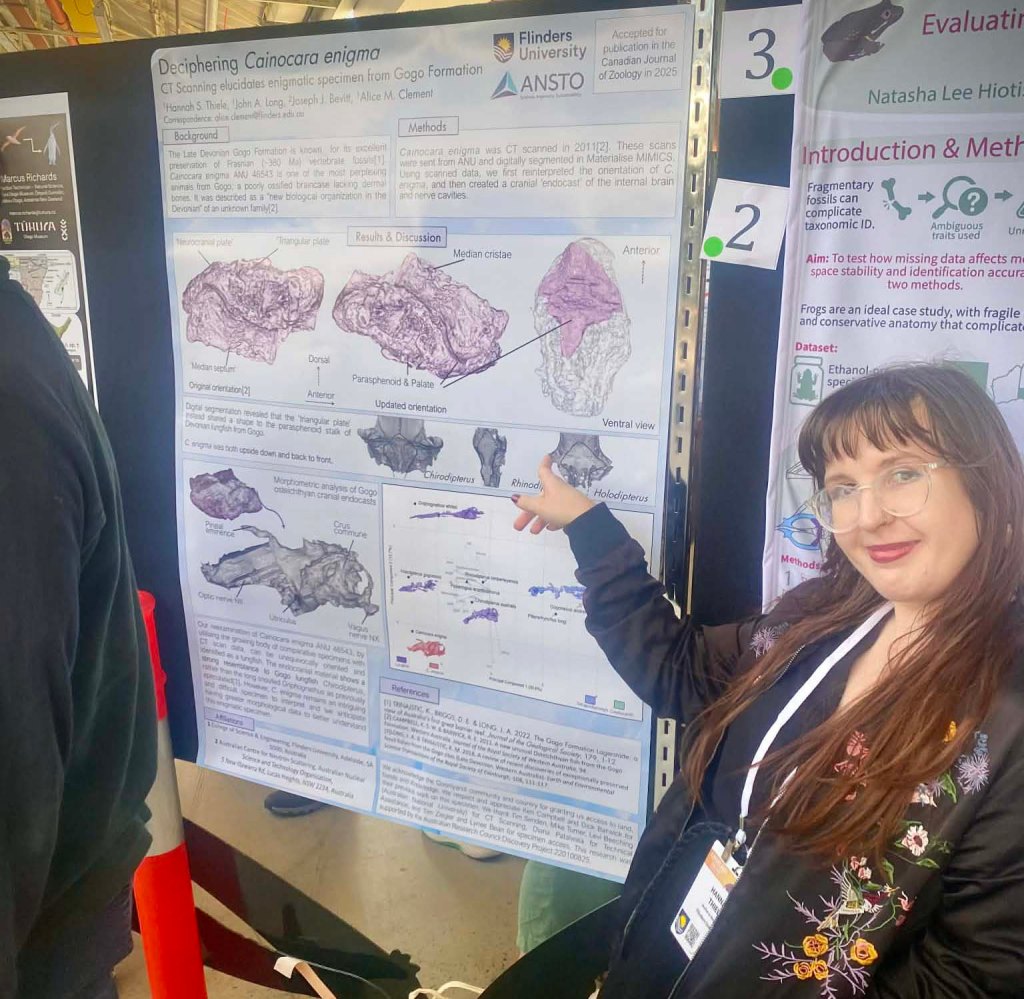
Lead author, Hannah Thiele, presenting her results on the Gogo enigma at the CAVEPS meeting in 2025.

If you are keen to read more, see the news article “Missing pieces added to ancient global fish puzzle” published on Scimex. After this work, Hannah continued her study on fish brains at Flinders University, and has now commenced her PhD.

4th International Coelacanth Symposium

Do you know what was the greatest zoological discovery of the 20th century? Many people would probably say that it was the discovery and identification of a living coelacanth fish (Latimeria), dragged up from the oceanic depths off the coast of Southern Africa. This discovery revived a lineage of fish that had been thought extinct for 70 million years!

Alice Clement with Latimeria chalumnae, at the JLB Smith Institute of Ichthyology in Makhanda (Grahamstown, South Africa)

I’ve written about coelacanths several times before: fossil ones, living ones, and even “living fossil” ones, but this month was the first time I attended a scientific symposium dedicated wholly to this enigmatic and enduring group of fishes.

I was fortunate enough to attend the 4th International Coelacanth Symposium, held at Josai University, in Tokyo, Japan. The meeting was co-organised with Aquamarine Fukushima Marine Science Museum and attracted speakers from 7 countries (somewhat remarkably spanning all 6 continents except Antarctica).

Coelacanth scientists at the 4th ICS. Back row, L-R: Frensly D. Hukom (Indonesia), Gaël Clément (France), Yoshitaka Yabumoto (Japan), Camila Cupello (Brazil), Paulo M. Brito (Brazil), Alexis Chappuis (France), Alice Clement (Australia), Shinya Miyata (Japan), Yuji Takakuwa (Japan), Shinya Yamauchi (Japan). Front row: Masamitsu Iwata (Japan), Kerry Sink (South Africa), Tatsuya Hirasawa (Japan), Augy Syahailatua (Indonesia).

The speakers were a diverse range of scientists who covered everything from ecology and conservation of living populations, anatomy, as well as the evolution and disparity of fossil forms, and much more. I spoke about our recently described new fossil coelacanth from Australia, Ngamugawi wirngarri, and rates of evolution in the group since their appearance in the fossil record ~410 million years ago.

Many thanks to the organising committee (Masamitsu Iwata, Yoshitaka Yabumoto, Paulo M. Brito, and Shinya Miyata) for such a fabulous meeting, and I am very much looking forward to the next one (2027 in Indonesia, perhaps?). We were very well looked after in Tokyo, and it will be an honour to collaborate with this fabulous group of researchers!

ありがとうございました!!!