It seems I had such a “SPring” in my step, I completely forgot to write about my trip to Japan in November last year!
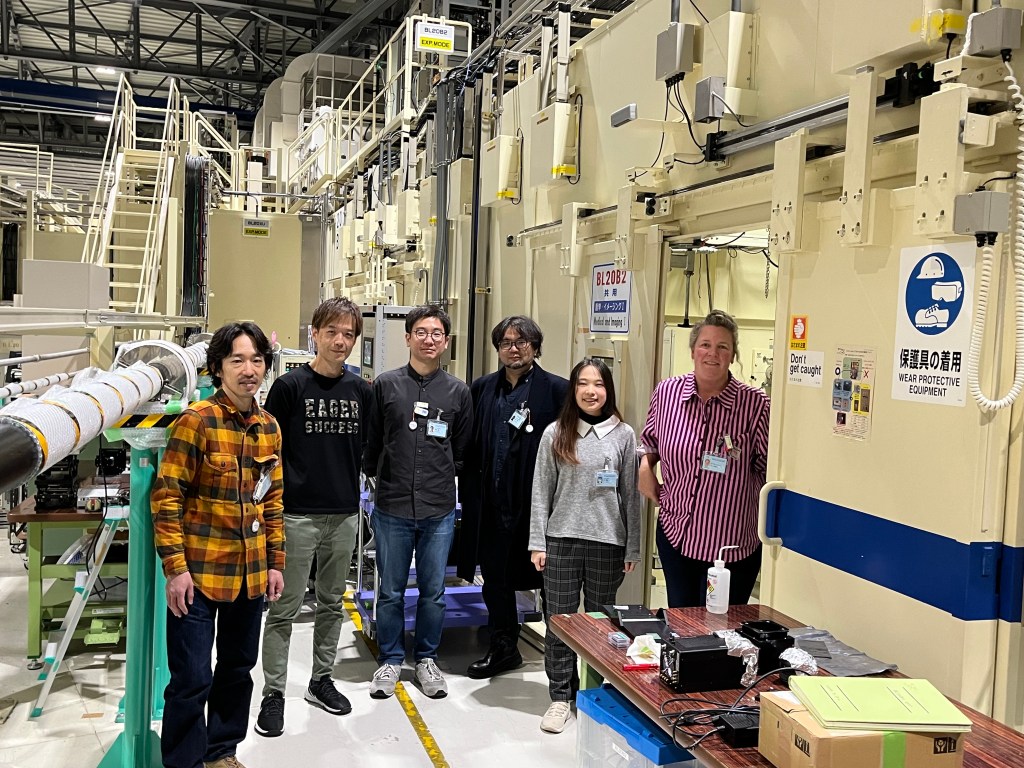
Thanks to a Flinders University International Research Engagement grant, I had the means to visit SPring-8 (the world’s largest third-generation synchrotron radiation facility) to work with my collaborator A/Prof. Tatsuya Hirasawa scanning embryos of the Australian lungfish, Neoceratodus forsteri.
The Japanese synchrotron, known as SPring-8, is nestled atop a mountain in Hyōgo Prefecture in the Kansai region of Japan. The nearest major cities are Osaka and Kobe. Sika deer amble through the grounds which are frequently shrouded in fog (they inspired me to write a haiku), and somewhat unusually for synchrotron facilities, there are paths to ride bicycles inside!

Sika deer through fog
SPring-8 autumnal mountain
Embryos revealed.
I was there working with Tatsuya Hirasawa and his team to image an ontogenetic (referring to the development of an organism throughout its lifespan) sequence of the Australian lungfish. I’ve previously worked on this animal to describe aspects of its brain (Clement et al. 2015) and muscle (Ziermann et al. 2017) anatomy (but see also Challands et al. 2020 where we discuss brains AND muscles in the same paper!)
Even though I had worked at the ANSTO Australian Synchrotron and ESRF in Grenoble before, I had never scanned tiny embryos of animals, and so learnt a lot about the preparation and parameters best suited to this kind of material. Other researchers working with us included Hiroki Higashiyama, as well as Toru Kawanishi and Kiiri Hama, respectively scanning either chicken embryos or bichir fish fins.
Following on from our successful synchrotron experiment, I spent a week in Tokyo. I was honoured to give an Evolutionary Morphology seminar at the beautiful and historic campus of the University of Tokyo (those ginkgo leaves!) and visit Tatsuya Hirasawa’s lab. Tatsuya Hirasawa and his group analyse fossil specimens using synchrotron radiation, as well as developmental genetic analyses of living animals at the gene and cellular level to investigate “Evo-Devo” of vertebrates. To his group and other guests from various institutions in Tokyo, I presented research on “Digital Palaeontology of the Early Vertebrates” to a very engaged and interesting group.


I also took the opportunity to travel nearby Tsukuba to visit A/Prof. Daichi Suzuki (University of Tsukuba), whom I had met recently at the ISELV meeting in Quebec. He investigates the evolutionary origin of the vertebrate brain and consciousness, which is absolutely fascinating! Whilst there I got to look at some cool lamprey scans he and his students are working on, and give a palaeontology seminar. Biiiiiiiiiiiiiig thanks to the amazing Chisako Sakata for the tour of the National Museum of Nature and Science Tsukuba Research Center!


I had such a wonderful time in Japan, AND was lucky enough to get back briefly less than two months after this visit for the 4th International Coelacanth Symposium, also held in Tokyo. Two visits in close succession was a great reason to revive my old high school Japanese… (また日本に行きたい!) That being said, I can’t wait for the next trip!!!
 Dr Alice Clement