
Snakes, lizards, turtles, crocodiles, dinosaurs… these are all reptile animals, and were thought to have first appeared about 315 million years ago in a time period called the Carboniferous (Bashkirian). The oldest evidence of these animals, amniotes, which eventually gave rise to all reptile, birds and mammals alive today, was known from sites in Europe and North America.
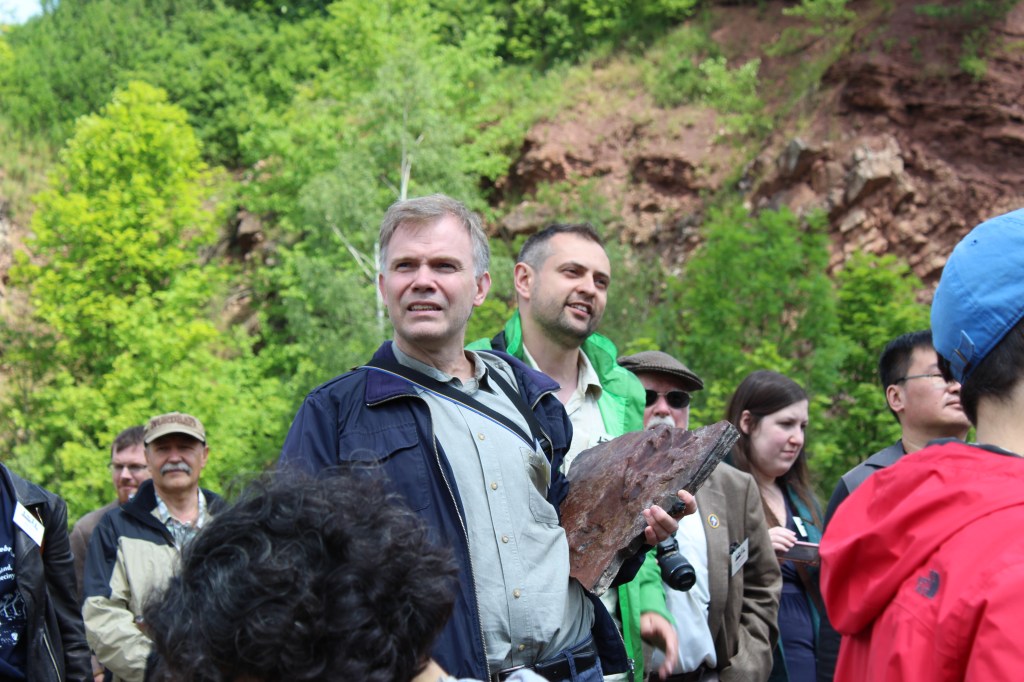
Imagine a palaeontologists’ excitement then, when enthusiastic fossil fossickers from Mansfield, Victoria, get in touch about an interesting slab of rock they have found in even older Carboniferous rocks. Citizen scientists John Eason and Craig Eury discovered a slab of rock from Taungurung Country, Mansfield, covered in trackways (fossil footprints) showing not just distinct toe imprints, but obvious claw marks, meaning these must have been made by an amniote, not amphibian, track maker.
The age of these rocks is securely dated, and so our finding pushes pack the known origin of reptile-like animals ~35 million years older than previously known!
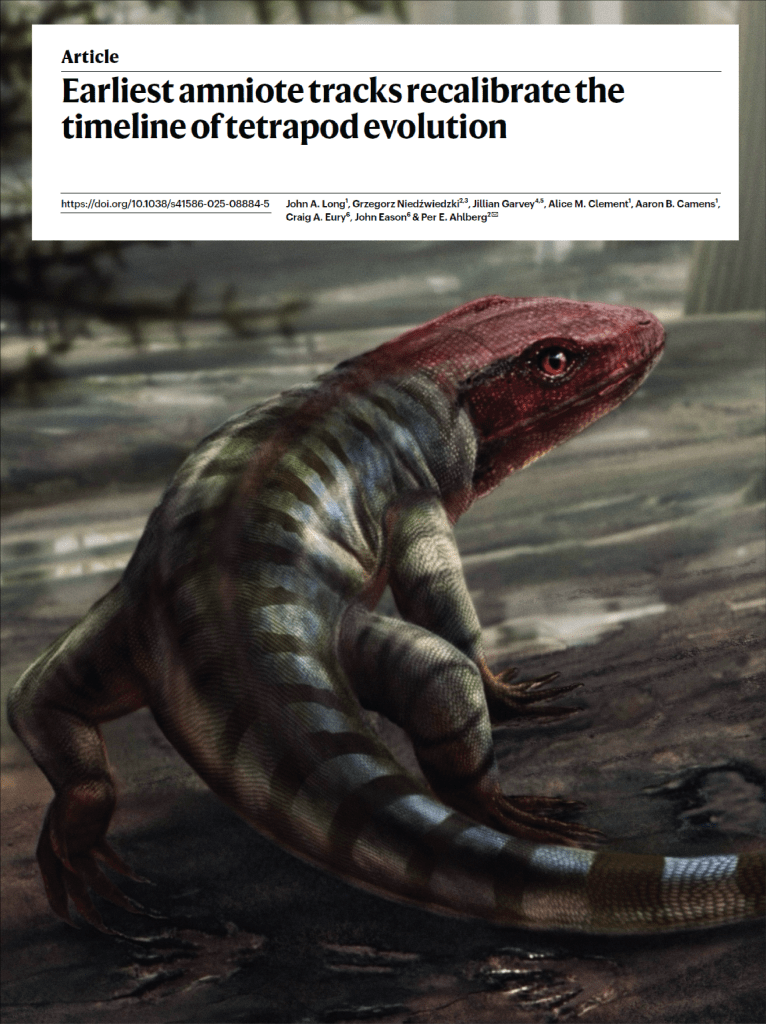
The team are thrilled to announce our latest paper was published today in the highly prestigious journal Nature, Earliest amniote tracks recalibrate the timeline of tetrapod evolution, led by Prof John Long, our amazing citizen scientists, John Eason and Craig Eury, who found the fossil, as well as Grzegorz Niedźwiedzki, Jillian Garvey, Aaron Camens, Per Ahlberg, and myself.

Polish artist Marcin Ambrozik recreated a life reconstruction of “Manny” our adorable little 350 million-year-old amniote, and Monkeystack Creative Studio bought them to life in the awesome video below:
This discovery has significant implications not only for reptile evolution, but for all tetrapods (four-limbed animals with backbones). By pushing back the earliest origin of reptile-like animals to the earliest Carboniferous (Tournaisian), it means that the records of other earlier groups (with complicated names like temnospondyls, seymouriamorphs, diadectomorphs, baphetids and colosteids) might have much older origins than previously appreciated and require some level of “re-calibration”.
Even more excitingly, I think this discovery sheds light on Australia, as part of the ancient supercontinent of Gondwana, as a place ripe for exploration and other major discoveries. Who knows what else lies out there awaiting discovery?
Want more?
- Read about the discovery in The Conversation “Two lizard-like creatures crossed tracks 355 million years ago. Today, their footprints yield a major discovery“
- Video published on The Guardian “Fossil footprints found in Australia the oldest evidence of amniotes”
- Flinders University News Website “Fossil tracks revise march of early life on Earth”
- Stuart Sumida wrote a News & Views article Track record: unexpectedly early reptile claw prints found

 Dr Alice Clement